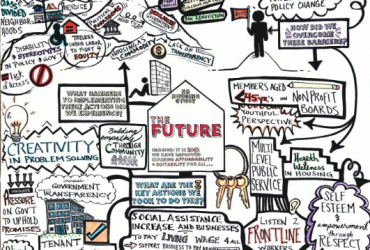
This community event explored why encampments are increasing in Saint John and outlined human-rights-focused solutions grounded in expert insight and the realities of systemic housing insecurity.
It’s no secret that encampments in the city of Saint John, New Brunswick have been on the rise over the last several years, as they have been all over the country. But how did we get here? And even more importantly, what can we do about it now? Many people are feeling angry and unsure where to turn for solutions. To help answer these questions, HOME-RL hosted a community dialogue on September 25th where we heard from Dr. Laura Pin, a leading scholar on housing policy and encampments at Wilfrid Laurier University in Ontario, alongside a panel of local experts with lived experience.

Why are encampments on the rise?
The first thing to understand is that homelessness and living in encampments is not a personal choice or personal failure. As Dr. Pin explained it’s “the predictable result of a long history of underinvestment in social housing” (2025). Multiple other factors have also contributed to the current state of homelessness, including:
- Weak tenant protection
- Unaffordable private market housing
- Insufficient social assistance
- Inadequate harm reduction
Dr. Pin also highlighted that for Indigenous people, there is a different definition of homelessness established by Jesse A. Thistle, a Métis scholar, which considers 12 dimensions of homelessness rooted in both current and historical contexts.
What are local experts saying?
In Saint John, Misty Schofield of Fresh Start Services for Women explained that locally, the COVID-19 pandemic led to a drop in vacancy rates and an increase in rent. This, along with an increase in the cost of living and very low income-assistance rates, has left many people unable to meet their basic needs in a province with minimal tenant protections. Johanne McCullough from Street Team Saint John, a grass-roots outreach group, added that the majority of people are much closer to homelessness than they realize stating, “When you are living paycheck to paycheck, it can take just one unexpected expense to make life unaffordable.” Connor, a local lived expert, explained how everything becomes a struggle when you are unhoused with all energies being spent on meeting basic needs and trying to stay afloat. As easy as it is to end up unhoused, it is incredibly difficult to secure housing after experiencing homelessness.
What can we do about it?
Acknowledging the reality that encampments exist - and that they are the direct result of government underinvestment social, supportive, and affordable housing - is a crucial first step to finding a solution (Pin, 2025). It is key to remember that homelessness is not the result of a personal failing, nor are people choosing to live in this situation. Moreover, encampments are a human rights issue, as the right to housing is enforced in international law, and has been recognized and committed to by the Canadian government. In order to address the needs of encampment residents, the best approach is one centered around Human Rights. Among other things, this approach includes decentering police by:
- leading with outreach, not law enforcement
- not forcibly removing temporary residential structures
A Human Rights based approach also includes providing encampments residents with the same basic municipal services received by other residents (e.g. water, sanitation) as well as social supports. For this to work, we need to make sure that encampment residents are meaningfully involved in decisions that impact them, following the concept of “Nothing about us, without us” coined by Black, disabled activists. We must also recognize the distinct rights of Indigenous people, and fund Indigenous-led outreach and leadership in this field. Lastly, we need to demand meaningful change at all levels of government. Municipal governments can effect change in the form of low barrier emergency shelters, provision of public land for low barrier housing, and orienting existing systems towards a human rights approach (e.g. providing training for bylaw officers); and provincial and federal governments, in the form of reinvestment into deeply affordable housing and increased rates of financial assistance.
The key takeaway from this community dialogue event is that encampment residents are community members and care and support must provided in a way that meets people where they are at. There are solutions to this systemic problem that also meet our obligations to uphold human rights, and we must urge our governments to choose to use them.
By Zoe Carvell
Zoe is a Social Work student at UNB and an undergraduate research assistant with HOME-RL.